
Cut EV HVAC Draw 16–18%: Ceramic vs Carbon Tint & Installer Questions
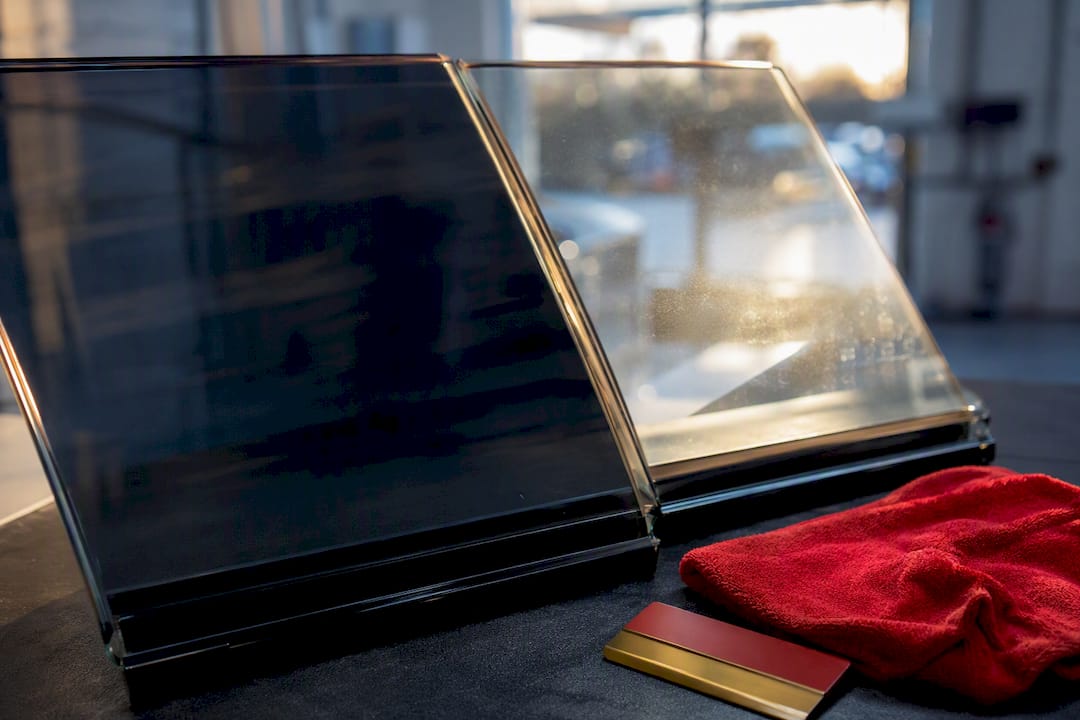
Ceramic tint is the better buy if you want the strongest heat rejection, the clearest optics, and a film that still looks new a decade from now. Carbon tint is the better buy if you want a real upgrade over dye-based film without paying premium prices. Choose ceramic for long commutes, outdoor parking, EVs, or a vehicle you plan to keep for years. Choose carbon if your budget is tight, you garage your car, or you just want reliable heat and UV protection without the top-tier price tag.
TL;DR:
Ceramic tint offers up to 70% infrared rejection, significantly outperforming carbon tint’s typical 35 to 45%, especially in prolonged outdoor exposure or for EV range preservation.
Both films block approximately 99% of UV rays and have similar signal compatibility, but ceramic provides a longer lifespan of 10 to 15 years versus 7 to 10 years for carbon.
The cost difference favors carbon at around $150 to $400, while ceramic ranges from $400 to $900, with larger glass areas and outdoor parking increasing ceramic’s value.
Proper installation, including glass prep and curing, is essential for both, with warranties covering material defects and application quality, and should be verified in writing.
Environmental impact favors longer-lasting ceramic films, which produce less waste over time, though neither material is widely recyclable at scale.
Table of Contents
Ceramic vs Carbon Window Tint: The Quick Comparison
Before we get into the mechanics of how each film works, here’s the shorthand version we give customers standing in their driveway trying to decide.
Heat/IR rejection: Ceramic films can reach up to roughly 50 to 70% infrared rejection, while carbon typically lands around 35 to 45%.
UV protection: Both block about 99% of UV rays, so sun damage protection is a wash between the two.
Durability: Ceramic often carries 10 to 15 year lifespan claims with strong fade resistance; carbon typically runs 7 to 10 years before color shift becomes noticeable.
Cost: Carbon jobs often start around $150 to $400 for a full vehicle, while ceramic runs roughly $400 to $900 depending on brand and glass area.
EV owners take note: Better IR rejection means your air conditioning works less to fight cabin heat, and in controlled testing that translated to 16 to 18% lower HVAC energy draw, which shows up as real preserved range on a hot Arizona drive.
Those numbers tell most of the story, but the “why” behind them matters just as much when you’re the one paying the invoice.
What Ceramic Tint Is and How It Works
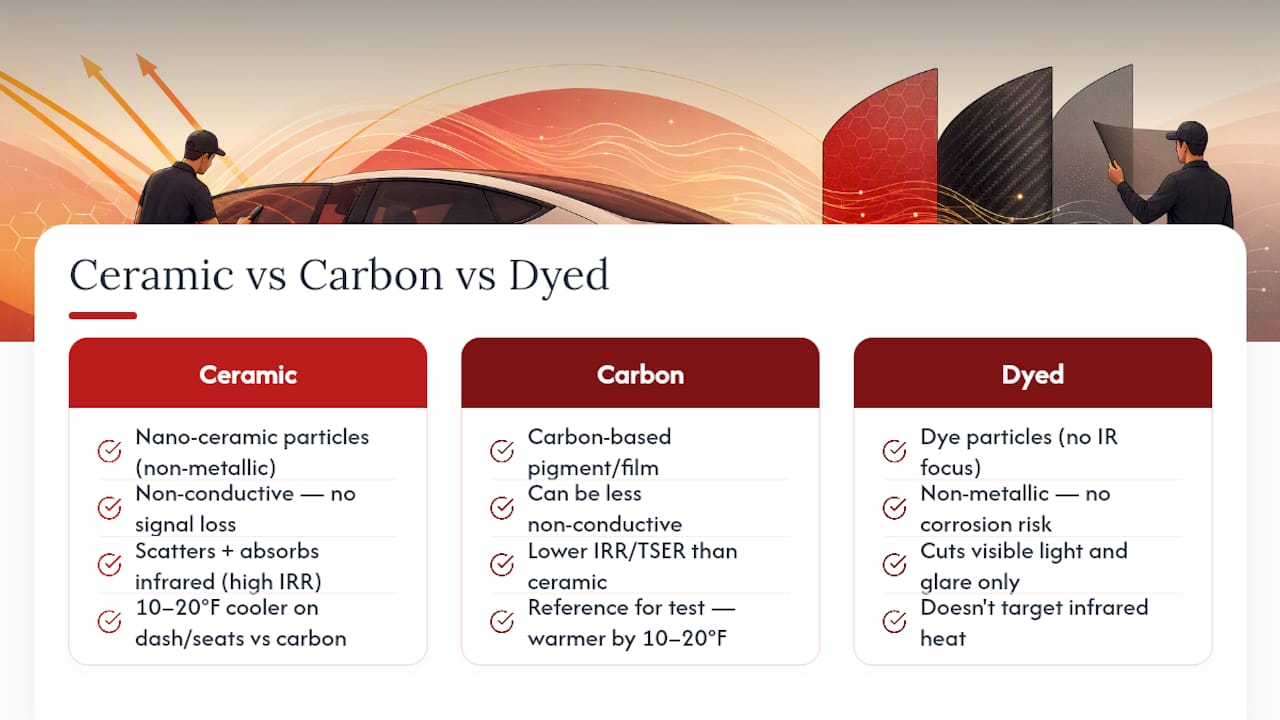
Ceramic tint uses nano-ceramic particles, tiny non-metallic mineral compounds embedded in the film layer, instead of the metal or dye particles older films relied on. Because those particles are non-conductive, ceramic film won’t interfere with your phone signal, GPS, or key fob, and it won’t corrode the way some older metalized films did.
The nano-ceramic particles work by scattering and absorbing infrared radiation before it ever reaches the glass, rather than just darkening the cabin visually. That’s the mechanical difference that separates ceramic from a basic dyed tint: dyed film mostly cuts visible light and glare, while ceramic specifically targets the invisible heat wavelengths that bake your dashboard and steering wheel.
Statistic Callout: In controlled surface-temperature tests, ceramic-tinted glass measured 10 to 20 degrees Fahrenheit cooler on dash and seat surfaces compared with carbon film under identical sun exposure.
That gap is the reason ceramic commands a premium price. Manufacturers like 3M, LLumar, and Ceramic Pro all publish TSER (Total Solar Energy Rejected) and IRR (Infrared Rejection) figures for their ceramic lines, and those published numbers tend to sit well above carbon competitors in the same catalog. Warranty terms usually follow the performance claims. Many premium ceramic lines carry lifetime or limited-lifetime manufacturer warranties against fading, cracking, and bubbling, which is a meaningful signal that the manufacturer trusts the film to hold up.
Ceramic isn’t magic, though. It reduces heat load dramatically, but it won’t make a black interior comfortable to touch after four hours in a parking lot in July. What it does is shrink the recovery time. Your air conditioning reaches a comfortable cabin faster, and it works less hard to maintain it, which is where the real-world benefit shows up mile after mile rather than in a single dramatic before-and-after photo.
What Carbon Tint Is and How It Works
Carbon tint gets its performance from carbon particles distributed through the film, which absorb infrared light rather than letting it pass through to heat the cabin. It’s a genuine step up from dyed film, and for a lot of drivers, it’s the sweet spot between price and performance.
Here’s what carbon actually delivers for the money:
Solid infrared rejection in the 35 to 45% range, enough to notice a real difference on a hot afternoon commute.
UV blocking around 99%, matching ceramic and protecting upholstery and dashboard plastics from sun damage just as effectively.
A distinctive matte, non-reflective black finish that many owners prefer over the slightly metallic sheen of older dyed films.
Color stability that holds up well for years, though not quite as long as premium ceramic before you’ll notice any fading or a slight purple or blue cast.
A lower price point that makes a full-vehicle job accessible without financing an upgrade you can’t justify.
Carbon becomes the smarter choice when your car spends most of its life in a garage, your commute is short, or you’re simply not willing to pay the ceramic premium for marginal gains you won’t feel every day. It’s also a strong fit for a car you plan to sell or trade within a few years, where you want the upgrade in comfort and looks without maximizing every dollar into the glass.
Heat, UV, Durability, Cost, Clarity, and Signal Safety: The Full Breakdown
This is where the decision usually gets made, so let’s walk through each dimension the way we’d walk a customer through it standing next to their car.
Heat and infrared rejection
The infrared spectrum is what actually cooks your cabin, not visible light. Ceramic film’s rejection rate can climb toward 70% in top-tier products, while carbon typically holds in the mid-30s to mid-40s percent range. On a 100-degree Arizona day, that difference shows up as a dashboard you can actually rest your hand on within a few minutes of starting the drive, instead of ten.
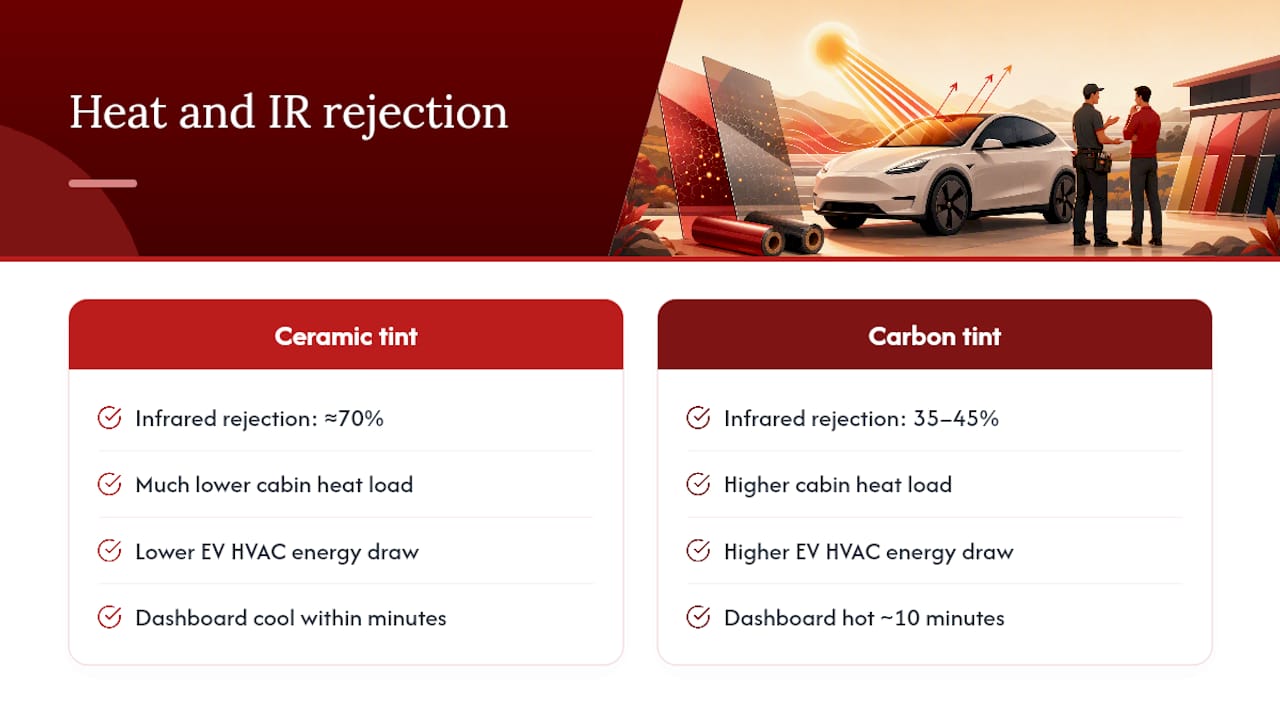
For EV owners, this isn’t just a comfort question. Cabin heat load forces your climate system to work harder, and that draws directly from your battery instead of a gas tank you can refill in five minutes. The HVAC energy savings we mentioned earlier translate into real preserved driving range on the hottest days of the year, which matters more the longer your commute runs.
UV protection
Both films block roughly 99% of UV radiation, so this category is genuinely a tie. If UV protection alone were your deciding factor, you could save money and go with carbon without giving up meaningful protection for your skin or your interior.
Durability, lifespan, and color stability
This is where ceramic starts to justify its price tag over the long haul. Premium ceramic film commonly carries a 10 to 15 year lifespan claim with strong resistance to fading, bubbling, or the dreaded purple shift that plagues older dyed films. Carbon typically runs 7 to 10 years before you’ll start to notice any color drift, which is still a solid run for a mid-tier product, just not in ceramic’s league.
Climate matters here too. A vehicle that spends its life outdoors in intense sun will stress any film faster than one that’s garaged most of the week, so factor your own parking habits into which lifespan number is realistic for your situation.
Cost
Statistic Callout: Expect carbon film to run roughly $150 to $400 for a full vehicle, while ceramic typically lands between $400 and $900 depending on brand tier and how much glass your vehicle carries.
Vehicles with panoramic sunroofs, large rear windshields, or extensive glass area amplify ceramic’s advantage, since there’s simply more surface area benefiting from the higher rejection rate. On a coupe with modest glass, the gap between carbon and ceramic performance is less dramatic than on an SUV with floor-to-roof windows.
Appearance, clarity, and glare
Carbon delivers a flat, matte black look that a lot of owners specifically request for its aesthetic, independent of performance. Ceramic tends to look more neutral and glass-like, with less haze and better optical clarity at the same visible light transmission (VLT) percentage. For night driving, ceramic’s superior clarity usually means less distortion and glare from oncoming headlights, a detail that matters more than most buyers expect until they’re driving home at 9 p.m. in the rain.
Signal interference and electronics compatibility
Neither carbon nor ceramic causes phone, GPS, or radio interference, because neither material is metallic. That concern is a holdover from older metalized dyed films, which really did cause signal problems in some vehicles. If an installer tries to warn you off ceramic or carbon over signal issues, that’s a red flag worth noting.
How to Choose the Right Tint (and What to Ask Your Installer)
Matching the right film to your situation comes down to a handful of honest questions about how you actually use your vehicle.
How much direct sun does your car sit in? Outdoor parking, long commutes, and hot climates all tip the math toward ceramic.
Do you drive an EV or a vehicle with a lot of glass? Panoramic roofs and EV range concerns both make ceramic’s higher rejection rate pay for itself faster.
What’s your budget ceiling for this upgrade? If carbon gets you comfortably under budget and ceramic doesn’t, carbon is still a legitimate upgrade over dyed film.
How long do you plan to keep the vehicle? A five-year ownership window makes carbon’s shorter lifespan a non-issue; a ten-year window favors ceramic’s longevity.
What look are you going for? If you specifically want that deep matte finish, factor that preference in alongside the performance numbers.
Once you know your priorities, the installer conversation should get specific fast. Ask for the exact brand and product series, not just “ceramic” or “carbon” as a category. Ask for the published IR/TSER figures for that specific film, and ask to see a VLT sample under actual daylight rather than trusting a swatch under fluorescent showroom lighting. Confirm the warranty terms in writing, including whether it covers bubbling, fading, and peeling, and ask what the removal policy looks like if you ever need the film taken off for a sale or a repair.
Watch for a few red flags. Vague answers about “premium” or “top of the line” film without a named product or spec sheet usually mean you’re being upsold on marketing language, not performance data. Pressure to upgrade to the most expensive tier without asking about your actual driving habits is another sign the installer is selling a product, not solving your problem. And if two installers quote wildly different VLT percentages for what’s supposedly the same film, someone isn’t measuring correctly, or isn’t being straight with you.
Pro Tip: Ask your installer to apply a small test sample to one panel, or point you to a vehicle they’ve already tinted with that exact product. Photos and spec sheets tell you what a film should do; a sample in real sunlight tells you what it actually does.
Installation Quality, Maintenance, and Warranty Expectations
The film itself only tells half the story. A proper installation includes thorough glass prep, heat shrinking the film to match the curve of each window, careful edge sealing to prevent lifting, and a curing period before you roll the windows down again. Skip any of those steps, and even the best ceramic film on the market will bubble or peel prematurely.
Manufacturer warranties and installer warranties are two different things, and you want both in writing.
The manufacturer warranty covers defects in the film itself, like premature fading or delamination.
The installer’s workmanship warranty covers bubbling, peeling, or edge lifting caused by application errors, not material defects.
Confirm whether the warranty is transferable if you sell the vehicle, since some are and some aren’t.
Ask how long you need to wait before rolling down windows or using an automatic car wash, typically a few days to a week depending on temperature and humidity.
For ongoing care, stick to ammonia-free glass cleaners and a soft microfiber cloth. Ammonia-based cleaners can degrade the film’s adhesive and top coat over time, which is a common cause of premature failure that has nothing to do with the film quality itself. If you notice bubbling, visible peeling at the edges, or a noticeable color shift toward purple or blue, that’s your signal it’s time to consider replacement rather than waiting for it to get worse.
How Phenomenalautocare Approaches Ceramic vs Carbon
We install both ceramic and carbon film, and we don’t push customers toward the more expensive option just because it carries a bigger margin. Our process starts with a real conversation about how you drive, where you park, and how long you plan to keep the vehicle, because those answers matter more than any single spec sheet.
When we evaluate a manufacturer’s performance claims, we look past the marketing language to the actual published IR and TSER figures, and we’re willing to show customers those numbers rather than asking them to take our word for it. Our reputation, built on a 5-star rating from more than 250 customers across Arizona, comes from that kind of straight talk rather than upselling every job to the top tier.
Here’s what we always recommend asking any installer, including us:
The specific brand and product series being quoted, not a generic category name.
The film’s published warranty length and exactly what it covers.
The shop’s own workmanship warranty and its removal or repair policy.
A VLT sample you can see in daylight before committing to a full vehicle.
The Bottom Line: Pick Your Film, Then Verify the Details
If you drive a lot in direct sun, own an EV, or plan to keep your vehicle for the long haul, ceramic earns its higher price through stronger heat rejection and a longer service life. If your budget is tighter or your car spends most of its time garaged, carbon delivers real UV and heat protection at a price that’s easier to justify.
Whichever direction you go, follow the same three steps before you commit:
Get quotes from at least two or three installers and compare the exact product names, not just the price.
Verify the published IR/TSER figures and warranty terms in writing before the appointment.
Schedule installation with enough lead time to allow the recommended curing period before you need the vehicle for a road trip or a car wash.
A warranty is only as good as the installer standing behind it, so confirm both the manufacturer’s coverage and the shop’s workmanship guarantee before you sign anything.
Environmental Impact and Recyclability of Tint Materials
Window film, whether carbon or ceramic, is built from layered polyester with embedded particles and an adhesive backing, and none of it is widely recyclable through standard municipal programs. Most removed tint ends up in landfill waste rather than a recycling stream, since separating the thin film layers from adhesive residue isn’t economically practical at scale.
Ceramic film’s longer lifespan actually gives it a modest environmental edge here. A film that lasts 10 to 15 years generates less replacement waste over a vehicle’s lifetime than a carbon film cycled through every 7 to 10 years, even though the ceramic manufacturing process itself is more resource-intensive per square foot. Neither material contains the toxic heavy metals that some older tint technologies used, which is a genuine improvement over decades-old dyed and metalized films still circulating on the used film market.
If environmental impact factors into your decision, the most meaningful thing you can control is longevity. Choosing a quality product installed correctly the first time, and maintaining it properly to avoid premature failure, does more to reduce waste than choosing between carbon and ceramic on sustainability grounds alone.
Installation Complexity and Time: What to Expect
Both carbon and ceramic film install using essentially the same process: glass cleaning, precise cutting, heat shrinking to match window curvature, and careful edge application. The material itself doesn’t change the fundamental technique, but ceramic film’s cost and heat-sensitivity during shrinking mean installers often take extra care on ceramic jobs, since a mistake on premium film is a costlier mistake to fix.
A typical full-vehicle job, whether carbon or ceramic, runs about two to four hours depending on the number of windows, the vehicle’s glass complexity, and whether it includes a windshield strip or a full sunroof. Vehicles with heavily curved rear windows or panoramic roofs take longer regardless of film type, since those shapes require more precise heat shrinking to avoid bubbling later.
The bigger time variable is curing, not application. Ceramic and carbon both need several days to a week to fully cure and bond to the glass, during which you should avoid rolling down windows or running the vehicle through an automatic wash. Plan your installation date around that window rather than scheduling it the day before a road trip.
An Installer’s Honest Take on the Ceramic vs Carbon Debate
The conventional advice on this topic treats the decision like a simple upgrade tier, ceramic good, carbon fine, dyed bad, and moves on. That undersells how much your parking habits and glass area actually determine the payoff. A ceramic upgrade on a small coupe that lives in a garage delivers a much smaller real-world benefit than the same film on an SUV with a panoramic roof that bakes in a parking lot all day.
What gets overlooked most often is the installer question. Two shops quoting “ceramic” can be selling products with meaningfully different TSER numbers, and the spec sheet matters more than the category name on the invoice. We’d rather see a customer choose quality carbon film from a straight-shooting installer than premium ceramic from someone who can’t tell them the actual IR rejection number.
Prioritize the installer’s transparency first, then the film category, then the price. Get that order right, and you’ll end up satisfied with either choice.
— Phenomenal
Get Professional Tint Installation That Matches Your Priorities
This service provides clear answers without upselling. The team walks you through actual IR and TSER numbers for the specific carbon or ceramic film you’re considering, then matches the recommendation to how you actually drive and park.
Because we come to you, there’s no shop drop-off and no waiting around a lobby while your car sits on someone else’s schedule. We bring the same premium products and personalized approach to window tint installation that we apply to our ceramic coating and paint correction work, and every job carries a workmanship warranty we’ll explain in plain terms before you book. If you’re in the Phoenix area and ready to move forward, schedule your mobile detailing appointment and we’ll walk you through film options during your consultation.
Sources
For readers who want to dig into the underlying lab data and manufacturer specifications behind this comparison, these are worth bookmarking:
FAQ
Is ceramic worth it over carbon?
Ceramic is worth the extra cost if you drive an EV, park outdoors regularly, or plan to keep your vehicle for a decade or more, since its higher heat rejection and longer lifespan pay off over time. If your budget is tight or your car stays garaged most of the week, carbon delivers strong value without the premium price.
What are the disadvantages of ceramic tint?
Ceramic tint costs roughly $100 or more extra per vehicle compared with carbon, and it won’t fully eliminate heat buildup during hours of direct sun exposure. It also requires careful installation, since mistakes on premium film are costlier to fix than on budget alternatives.
Are ceramic tints worth the extra money?
For high-mileage drivers, EV owners, and vehicles with large glass areas like panoramic roofs, yes, the higher IR rejection and 10 to 15 year lifespan typically justify the added cost. For short commutes or garaged vehicles, carbon often delivers comparable day-to-day comfort at a lower price.
How can I tell if I have ceramic or carbon tint?
You generally can’t tell by looking at it; appearance alone isn’t a reliable test since both can look similar depending on the brand and VLT. Ask your installer for the product name and spec sheet, or request the original invoice, which should list the exact film series installed.
Does carbon or ceramic tint interfere with phone or GPS signals?
Neither carbon nor ceramic causes signal interference, since both are non-metallic materials. Older metalized dyed films were the ones that occasionally caused GPS or phone reception issues, not modern carbon or ceramic film.
Recommended
Comments